Anyone can build you a website. What almost nobody has done is write down how tree work is actually assessed and priced, in a form software can use.
This would be a much harder problem in a trade without standards. Tree work has them.
The ISA's risk assessment qualification lays out a systematic method at three levels of depth. ANSI A300 Part 9 covers risk assessment; the rest of A300 covers how the work gets done. Z133 covers doing it without hurting anybody.
So the job isn't inventing a way to think about trees. It's taking a documented professional method, encoding the judgment that sits inside it, and making it run a few hundred times a day.
A standard tells you the shape of the assessment. It does not tell you which species in your region fails the same way every storm, or that the outfit two towns over underbids hazard work and leaves the brush.
That part is local and it accumulates. It gets added a job at a time, with a note about the basis for it, so any recommendation can be traced back to the reason it exists.
Pinned to the property. Species, DBH, height, canopy spread, condition, the defects somebody noted, what was done to it and when, and the photos.
This is the boring one and it's the one everything else needs. A treatment plan, a seasonal reminder, a five-year maintenance contract: none of them exist without a record of the actual tree.
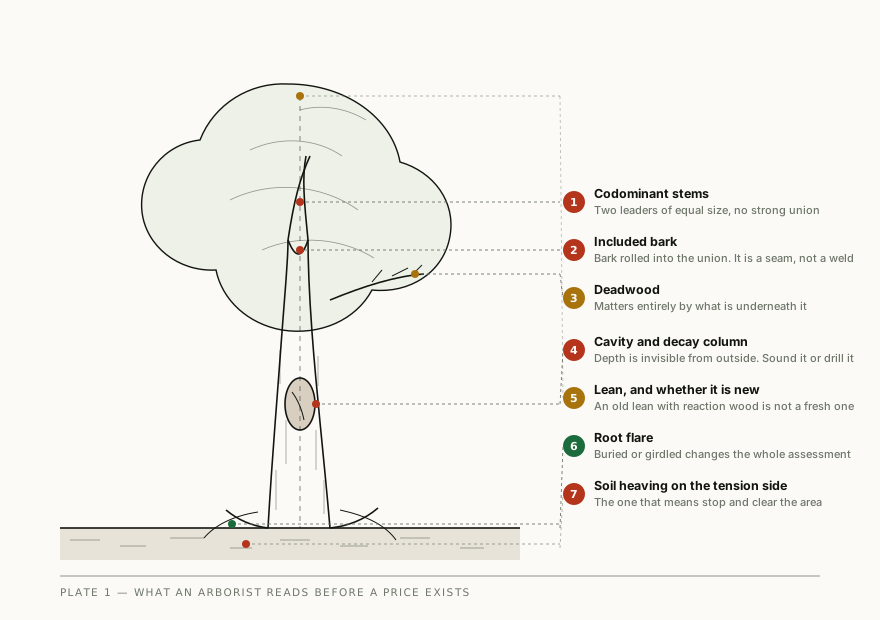
Deadwood in a mature oak over a driveway is a different conversation from the same deadwood at the back of a lot with nothing under it.
Included bark, codominant stems, cavities, root plate movement, fungal bodies at the base. The software learns to notice them and to say what it noticed, on the risk frame the ISA already defines.
It starts with the seven variables and your rate card. Then it watches what you actually charged against what it guessed, and closes the gap.
Six months in, it prices like you. That's also why leaving gets less appealing over time, and we'd rather earn it that way than with a contract.
Dormant pruning windows. When to treat for what. Which pests are actually moving in your county this year, not in general.
Emerald ash borer, oak wilt, spotted lanternfly. Real pressure, regionally specific, tied to the trees you already have on record.
Removal permit rules differ by municipality and homeowners almost never know theirs. Storm history differs. Dominant species differ.
That is what makes a page about a specific town worth reading instead of the same page with the name swapped.
Every before and after with the real details attached: height, how close, what method, which town.
It's the most convincing thing on your website and it's the thing nobody has time to write up. So it gets written up automatically from the record.
Same photograph, same three answers, two different addresses. The software should not produce the same output, and a general-purpose tool will.
Inside one tree-length of an occupied structure. Crane pick or piece-by-piece rigging. Access is good so the crane is cheaper than the labor. Oak wilt is present in the region, so timing the cut outside the vector season matters and the customer should be told why.
Output: a range assuming a crane, a note that the work should wait for dormancy unless it is a hazard, and a check of the removal permit rule for that municipality.
No structure, no line, no rigging. This is a notch and a back cut and a chipper. The price is a fraction of the first one and the skill required is different work entirely.
Output: a much lower range, no crane assumption, same oak wilt timing note because that's about the species and the county, not the address.
These aren't temporary limits waiting on a better model. They're the design.
A downed line in the frame doesn't get a booking. It gets told to call the utility and call 911, on a script we wrote once and don't let the software improvise on.