Built in public. Follow the build โ†’ TreePro.io
Your website

Not another green template with a chainsaw on it.

Most tree service sites look like they were bought from the same guy, because they were. Yours gets built from your work, your towns, your credentials and your trees.

Two readers

One page has to work for a woman in a driveway and a man comparing three quotes.

The emergency reader

A limb is on the roof. It's dark. Cell service is bad because half the neighborhood is on their phones too. She is not reading your About page.

  • A red band across the top, always there, never dismissible
  • A phone number that's a tap, in the HTML the server sends
  • Text a photo, because half of them can't describe it anyway
  • Nothing else competing for that moment

The researching reader

Planning to take an oak out in the spring. Three quotes on the counter. He's trying to work out why yours is eleven hundred more and whether that means anything.

  • Your certifications, with numbers he can check himself
  • Jobs like his, with the height and the method written down
  • What the price actually depends on, explained plainly
  • Insurance he can verify without taking your word
example tenant site
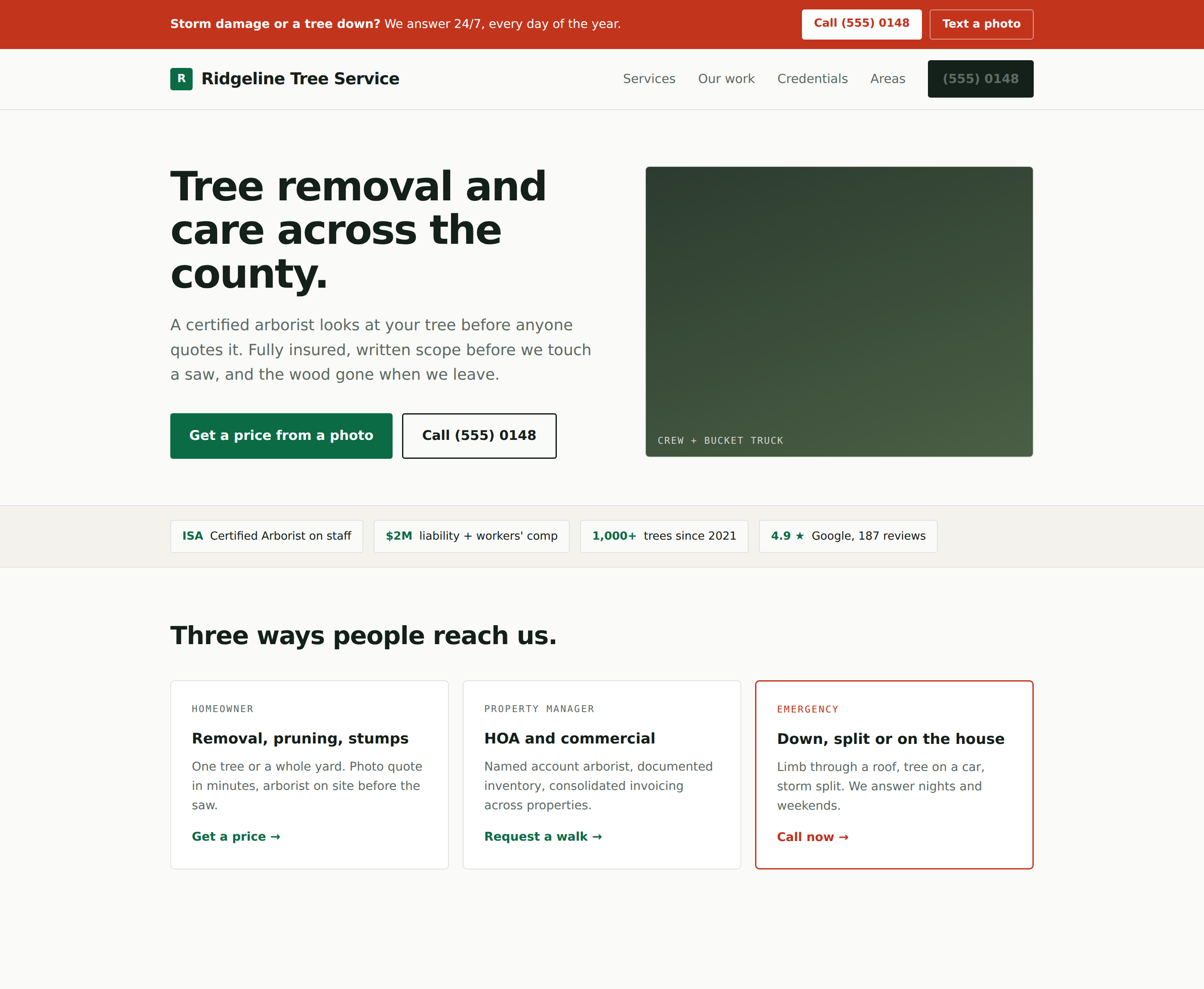
A tree company website with a red emergency band across the top, a photo-quote call to action, a trust strip of verifiable credentials, three doors for homeowner, property manager and emergency, and a before and after with the job detail written out.
An example, not a customer. Built from the record, not from a template. The red band is the only thing competing for the storm caller's attention, and everything below it is for the person comparing three quotes on a Sunday.
The thing most sites get wrong

They pick one reader and lose the other. A site built for the storm call reads thin to the guy comparing quotes. A site built to look impressive makes the woman in the driveway scroll past four sections to find a phone number. The emergency band solves it: one reader is served in the first inch of the page and the other gets everything below it.

The page that wins commercial work

A credentials page somebody can forward.

Property managers don't hire from a homepage. They hire from something they can paste into an email to their boss.

So there's one page with your general liability limit, your workers' comp, your ISA certification with the number, your accreditation if you have it, and the standards you work to. Each one verifiable by the person reading it.

Insurance gets requested from your carrier directly, because that's what buyers are told to demand and a PDF you host isn't the same thing.

What the homeowner has been warned about

Every consumer guide and half the state attorneys general say the same four things. Somebody knocking on doors in the three days after a storm. A price that's only good today. Cash only, nothing in writing. And won't produce a certificate of insurance.

Your site answers all four before she asks. A written scope. Card payment. A named certified arborist. Insurance from the carrier. Not as a list of promises, as the actual documents.

Proof

Your jobs, written up the way a climber would describe them.

"Tree removal in [your town]" is not proof of anything. This is:

From the record, written automatically

68 ft red oak, 6 ft off the garage

Crane pick over the roof because there was no drop zone and the gate wouldn't take a lift. Sectioned from the top, roped the limbs over the garage, full haul, stump ground to eight inches. One day, four-man crew.

September 2026 ยท residential street, two-car garage

Every number here already exists in the job record. Nobody has to sit down on a Sunday and write case studies. The write-up is a side effect of having done the work properly.

Before and after, with a slider on the photo itself. Filterable by service and by town, so the person two streets over comparing quotes can look at the jobs you have already done nearby.

Local search

Town pages that are worth the click.

You've seen the other approach. Forty towns, same paragraph, the town name swapped in. Google worked that out years ago and so did everyone reading it.

The rule

Facts or no page

A town page only gets built if there's something genuinely specific to say about that town. If there isn't, the page doesn't exist. Fewer pages because the facts ran out, not fewer pages on principle.

What counts

Real local detail

The removal permit rule, which differs by municipality and which almost nobody knows. The species that dominate those streets. What the last big storm did there. The neighborhoods by name.

The check

Built in, not optional

Before any of it ships, the pages get compared against each other. If a set of them reads like one template with the names changed, the build stops. That check can't be switched off to hit a page count.

Machines read it too

Half your customers will ask an assistant before they ask Google.

Somebody types "is there a certified arborist near me who does crane removals" into a chat window. Something has to answer that, and it answers from whatever it can read.

So the site ships machine-readable files alongside the pages: a plain-language index of what's on it, structured markup for your services and service area, and your certifications marked up as credentials belonging to a named person rather than as decoration.

That last one is the difference between an assistant saying "they claim to be certified" and "their arborist is certified, here's the number."

The site is half of it

The other half answers the phone at night and chases the estimate you forgot about.